Three ways couples seat themselves
The head table (or bridal table)
The couple and the wedding party along one side of a long table, facing the room. It is the classic arrangement, everybody can see you, and the speeches happen from behind it. It seats fewer people than you think — one side only — and nobody at it can talk to anyone behind them.
The sweetheart table
A small table for two. It removes every argument about who else belongs at the top table, gives your wedding party their partners back, and photographs beautifully. Some couples love the half hour alone together in the middle of the day; others find it isolating and end up standing up between courses.
The king’s table
A long banquet table with guests down both sides and the couple in the middle. Written as king’s table or kings table, it is the compromise most couples land on when the wedding party has partners: the same length of table seats roughly twice as many people. The cost is that the guests on the near side have their backs to the room, which matters for photographs and for the speeches.
The traditional order along a head table
The convention most etiquette guides describe is straightforward in shape, whatever the local variation:
- The couple sit together at the centre of the table.
- The honour attendants — the maid or matron of honour and the best man — sit immediately beside them, one on each side.
- The remaining bridesmaids and groomsmen alternate outwards from there, so the table reads as an alternating line rather than one side’s people and then the other’s.
- Everyone faces the room; nobody sits opposite anybody.
Which side the bride takes is where sources start contradicting each other, and it is genuinely not something your guests will notice or remember. Choose based on who each of you wants beside you, and on where the microphone is.
The one thing worth being deliberate about is the ends. The two people at the far ends of a head table have exactly one neighbour each and a long night ahead of them. Put your two most talkative attendants there, not the two quietest.
The partners problem
This is the real difficulty with a traditional head table. Your maid of honour’s husband is at the wedding, and a strict head table seats her away from him for the entire meal. There are four usual answers:
- Include the partners — which needs roughly double the table length, and is what pushes most couples towards a king’s table.
- Seat the wedding party with their partners at ordinary tables, and take a sweetheart table yourselves. The most popular modern solution, and the least contentious.
- Keep the traditional head table and seat partners together at a table directly in front of it, so nobody is far away.
- Keep the traditional head table only for the meal, and rearrange nothing — most people leave their seats after the speeches anyway.
Whichever you choose, tell your wedding party early. Someone finding out on the day that their partner is across the room is a small thing that lands badly.
Where the parents sit
With a wedding party at the head table there is usually no room for parents, so the standard arrangement is a parents’ table immediately in front of or beside it, holding both sets of parents, the grandparents, and often the officiant and their partner.
If the two families do not sit comfortably together, split them into two tables of equal standing, both close to the front, and fill each with that family’s own people. The same principle applies to divorced or separated parents — see how to make a wedding seating chart for the detail on that and on the other constrained cases.
How many seats you can fit
A head table seats along one side only, so it holds about half what the same table would as a banquet table. Working on about 61 cm of edge per person:
- One 8 ft (244 cm) trestle — about 4 seats.
- Two joined (488 cm) — about 8 seats.
- Three joined (732 cm) — about 12 seats.
Count the people you want there before you book the tables, not after. A couple plus four attendants each is ten people, which is three trestles — a table nearly seven and a half metres long, and quite a lot of wall. Full seat counts for every table shape are in how many guests fit at each wedding table.
Where to put it in the room
- Against the longest clear wall, centred, so the maximum number of tables can see you.
- Never in front of the kitchen door, a service lane or the toilet corridor.
- Check what is directly behind you — it is the background of every photograph taken during the speeches. A window with a view is a gift; a fire exit sign is not.
- Near the microphone and the sound system, since the speeches come from here.
- Leave a way out. A head table pushed flat against a wall means everyone at it has to shuffle sideways to leave, all night.
- Consider a low riser if the room is flat and long, so the back tables can see. Consider skipping it if the ceiling is low.
Building it into your plan
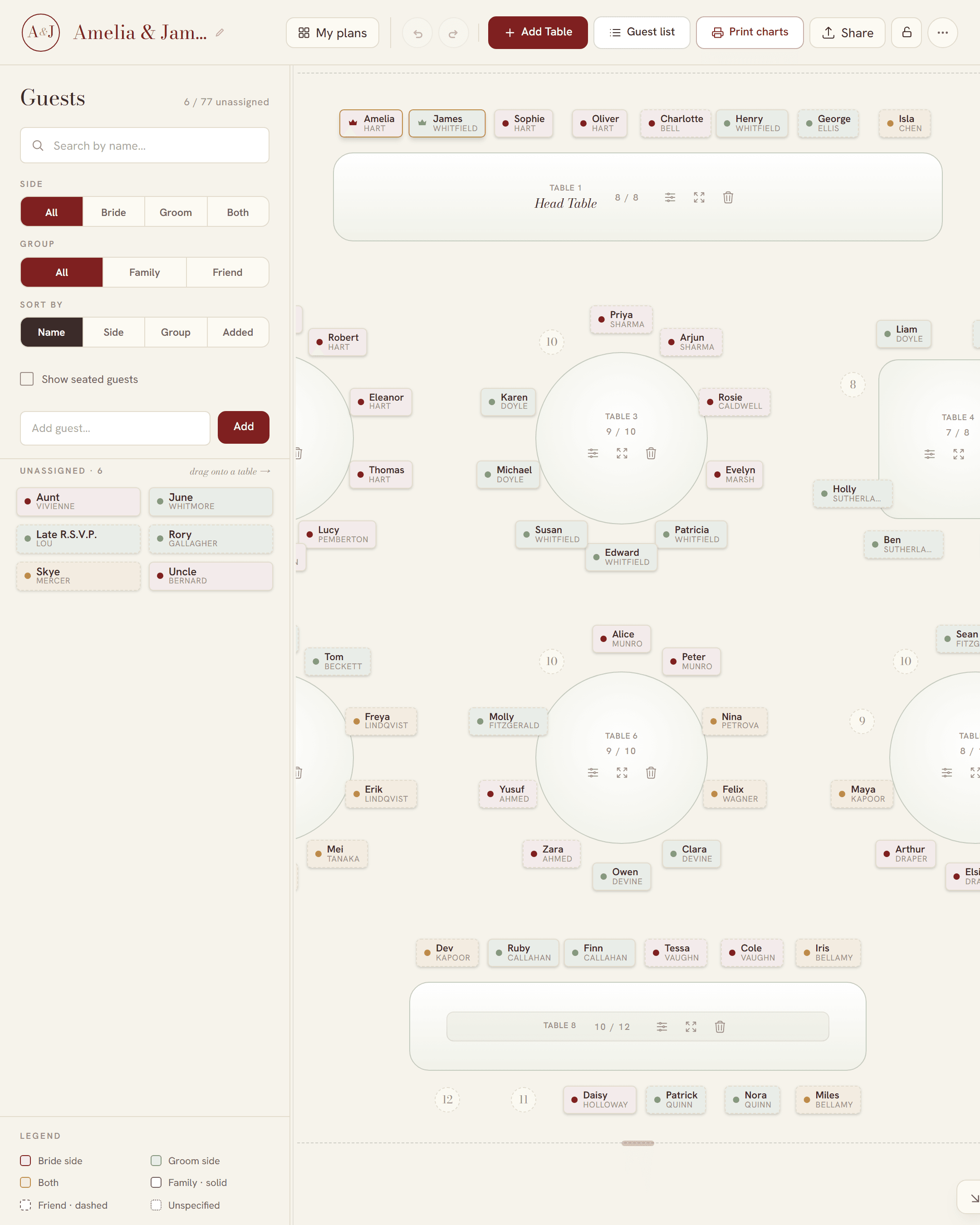
In SeatFlow the head table is a one-sided table: all the chairs sit along a single long edge, facing the room, the same way the real one will. Set the number of chairs to the number of people you are seating, drop each person into a specific chair, and drag the whole table into position on the floor relative to your round tables and the dance floor.
Because each chair is individually assignable, you can settle the order of the wedding party properly rather than leaving it to whoever arrives first. If you change your mind and switch the table to a different shape — a king’s table, say — the people already seated at it re-flow onto the new seat order rather than being turned out.
Start with the free wedding seating chart maker, or bring your list in from a spreadsheet via the guest list import.