Is it tacky to have uneven tables at a wedding?
No. Guests do not count the chairs at the next table. What they notice is who they sit with, and whether their own table feels full and easy to talk at. A table of 9 beside a table of 10 looks the same from the door.
Uneven tables are also the result of doing the job properly. Your guests come in groups: a couple, a family of five, six friends from work. If you force every table to the same number, you split the groups to do it. Seat the groups first and let the table counts fall where they fall.
How uneven can wedding tables be?
Within two guests is a good rule: tables of 8, 9 and 10 in the same room read as one size. A gap of four or more, such as a table of 5 beside a table of 10, is where the quiet table shows. Its guests have fewer people to talk to, and a lot of empty floor around them.
- Two apart (8 and 10): nobody will notice. Spread the place settings out and the table looks full.
- Three apart (7 and 10): past the rule, but it works if the smaller table is a close group who like the space.
- Four or more apart: move a group from the big table, or join the small table to a second small group.
These are rules of thumb, not etiquette law. The real limit is the size of the table you hire. A 5 ft (60 in) round seats 8 comfortably, and a 6 ft (72 in) round seats 10. The measurements are in how many guests fit at each wedding table.
How do I split my guests into tables of different sizes?
Pick the biggest table you want, work out how many tables that needs, then take one seat off as many tables as you have spare seats.
- Count the guests who have said yes and will sit down to eat, less the head table or sweetheart table. Do this after the RSVPs are in, since every decline changes the split.
- Choose the biggest table you will use, for example 10.
- Divide the guests by that number and round up. That is the number of tables.
- Multiply the tables by the biggest size and take away the guests. The answer is the spare seats.
- Take one seat off that many tables. Those become your smaller tables.
| Guests | Biggest table | Tables | Split | Sum |
|---|---|---|---|---|
| 23 | 8 | 3 | 2 × 8 + 1 × 7 | 16 + 7 = 23 |
| 43 | 9 | 5 | 3 × 9 + 2 × 8 | 27 + 16 = 43 |
| 61 | 9 | 7 | 5 × 9 + 2 × 8 | 45 + 16 = 61 |
| 87 | 10 | 9 | 6 × 10 + 3 × 9 | 60 + 27 = 87 |
| 134 | 10 | 14 | 8 × 10 + 6 × 9 | 80 + 54 = 134 |
You can put the smaller tables wherever suits the room. The split only decides how many chairs each table needs.
What do I do with a group that does not fit a table?
Keep the group together and change the table around it. Splitting a group of friends across two tables is the move most likely to leave guests unhappy.
- A family of 11 or 12 at tables of 10: give them one bigger table (a 6 ft round takes 12 at a squeeze), and seat everyone else at 10 or 9 as the groups fall.
- A group of 3 or 4: join them to another small group of the same age or life stage.
- One guest who knows nobody: put them with the most welcoming group you have, and tell someone at that table to look out for them.
- A couple who know nobody else: seat them where the group will take them in. A table of 9 or 11 is fine.
Mixed table shapes work the same way. A long table for the family and round tables for everyone else is common: see seating charts for long tables. For the head table, see head table seating.
Should the venue set the same number of places at every table?
No. Tell the venue the number of guests at each table, and ask them to set that many places. A table of 8 with 8 place settings looks full, while a table of 8 with 10 settings and two empty chairs looks as if someone did not come.
- Give the venue a list of tables with the guest count for each, not only the total.
- Ask for the spare chairs to be taken away from the smaller tables, and kept for the table that is over.
- Check that the venue or hire company can supply the table sizes you need. Mixing 5 ft and 6 ft rounds is a question for them first.
How do I plan uneven tables in SeatFlow?
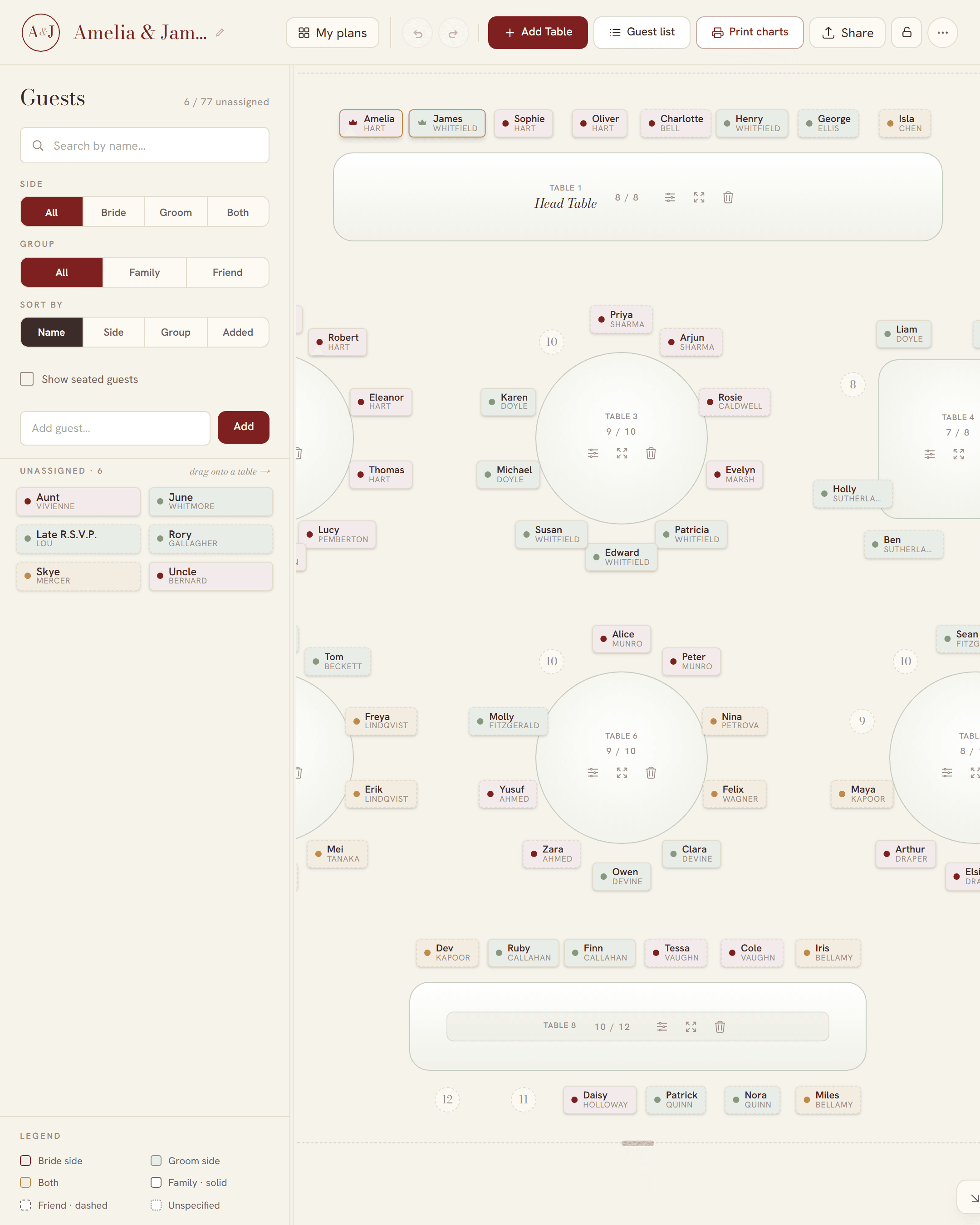
Every table in SeatFlow has its own seat count and its own shape. On a computer, a new plan opens with a short setup where you add a row for each kind of table, so 6 tables of 10 and 3 tables of 9 are two rows. In the setup each row takes 2 to 16 seats and one of four shapes: round, long, all-sides or one-sided. Once the plan is open, you can change any one table to anything from 1 to 50 seats.
- Add a row for each table size in the setup, or change a table's seat count on the board.
- Import your guest list from a spreadsheet (CSV), or type the names in.
- If you add your list in the setup, you can choose auto-seat to fill the tables as a first draft, grouped by side and family. It is a draft: move guests by hand to keep your own groups together.
- Drag guests between tables. Each table shows how many seats are filled, such as 9 / 10, and its panel shows how many seats are free.
- Share the plan link, then download the guest list, table poster, table number cards and place cards.
If a table has more guests than seats, SeatFlow does not stop you. The table shows “Over by 1”, so you can see it, and you decide whether to move someone or raise the seat count. Everything is free, with no sign-up. See how many tables you need for the full table count.